For the Queen
On the craft around the prompts, and why Alex Roberts’ little deck seems to run itself.
Most summers I give myself a creative project: some corner of game design I want to understand by making something inside it. This summer, the project picked me. My local group, the East Bay Story Gamers, has fallen hard for prompt games, the GM-less, deal-a-deck, no-prep kind: For the Queen, A Quiet Year, and their many cousins. Playing them week after week, I kept circling the designer’s question. How does so little do so much?
The prompts are where these games really live, and I have written about that craft before, in “The Power of the Prompt”: the best questions do three jobs at once, telling you about the world, about who you are, and about what has just been set in motion, and they do it not through what they ask but through what they quietly take for granted. That craft is the engine.
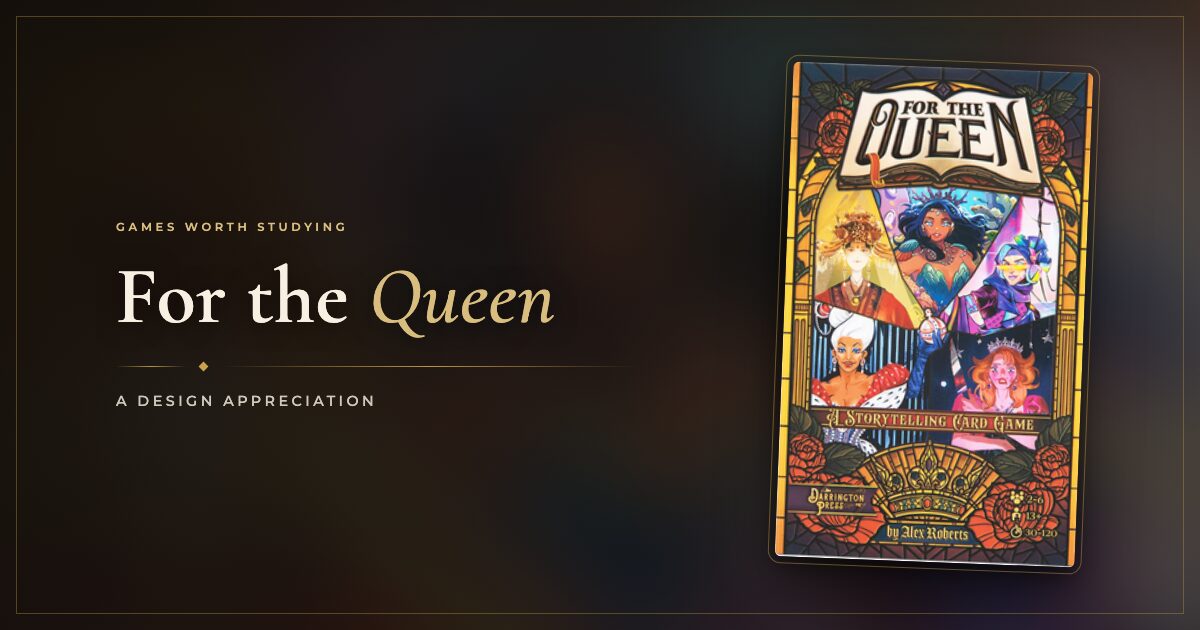
But an engine is only half of it. The prompts still have to be held and dealt in some order, with somewhere for their answers to land, and that surrounding frame is what I want to look at here, in the game that turned this kind of play into a genre: Alex Roberts’ For the Queen, first published in 2019 and reissued by Darrington Press in 2024. Here is what I think it gets right.
Getting started asks almost nothing of you. No game master, no preparation, no rulebook to study the night before. The rules are printed on the cards and taught as you deal them, and the only object on the table is a deck, a thing everyone already knows how to hold. Roberts has described arriving at the design by subtraction (in an interview in French): the first prototype leaned on a Jenga tower and dice, pared down over many iterations until all that remained was a stack of handwritten index cards. Setup is a couple of minutes. A whole game runs half an hour to two hours. This is one of the reasons it has been so popular for a weekday evening with the East Bay Story Gamers.
The queen you choose colors everything. The game ships not one queen but a whole deck of illustrated ones, and the one you settle on sets the story’s tone before a single prompt is read. A soft, sorrowful queen and a horned, imperious one grow very different stories from identical rules. That same picture is what lets the form flex genre: the crown can sit just as easily on a starship captain, a cult’s prophet, or the meanest girl in tenth grade. One small deck, played as tragedy, or horror, or comedy.
The feeling comes first. The premise lands before the first card is drawn. You belong to a Queen’s retinue, and you love her, though she is not always kind to you. A few short opening lines sketch that bond in broad strokes and still pin down something painfully specific about it, and then the game hands you a Queen no one at the table plays. Because no one speaks for her, no one can soften her or explain her away. You are emotionally invested before you have built a single thing.
The ending is fixed before you begin. The entire game is one suspended moment. The final card is the instant the Queen is attacked, which means every prompt before it is quietly asking you to build the hours leading up to that attack: history, not plot. And the deck is the clock. That final card is not fixed to the bottom; at setup you bury it somewhere in the back half, so once you are deep into the game you know the attack is near without knowing which turn will bring it. The thinning stack becomes a countdown you can feel, and the not-knowing-when is a quiet dread all its own, until the card the whole evening has been building toward finally turns over:
“The Queen is under attack. Do you defend her?”
Everything you have invented over the last hour is what decides your answer. The climax is certain; what fills it is entirely yours.
Even hard, intimate play stays safe. For the Queen was, as Jason Brown put it, the first game they had seen “that gives the players explicit permission to use the X Card as a narrative tool as well as a safety tool.” The X-Card normally lets anyone at the table pull the story back from something they would rather not play out, no reason owed; here you are also allowed to use that same pull for the story’s sake, waving off a thread not because it hurts but because the fiction is better without it. Between the queen you settle on and the freedom to wave a thread away, no two games arrive at the same place.
One sure sign that a design is sound is that it turns out to be copyable. Roberts released a reference document for the system, and the family that grew from it, “Descended from the Queen”, now runs to some forty+ published titles with a community how-to guide of its own. People do not clone a structure unless the structure is doing the real work.
None of this makes it the right game for every table, and it is worth being honest about what the form trades away. For all that it welcomes newcomers, a blank page can intimidate. Andrew Holmes reviewed it for Meeple Mountain having never played a roleplaying game before this one, and even he would not recommend it as a first RPG for a table where everyone is new: some of its questions carry undertones a brand-new player might not be ready to read. It prizes collaborative authorship over in-character conversation, so if the pleasure you chase is talking as your character across a table, this offers a different one. And the shuffled deck, the source of all that variety, is also its greatest weakness: every question has to earn its place no matter when it happens to fall, and honestly, not all of them will.
There is one more thing it left me wanting, and it is the useful kind of wanting. When that last question is answered, the game simply stops. There is nowhere to go after the decision, no falling action, no morning after. That empty space, the missing “and then?” is exactly what set me designing The Launch. But that is my next design diary.
So let me hand you the deck. If you have played For the Queen, or any of its many descendants, I would love to know which queen you drew, and what she made of you.
The best stories are the ones we tell together.
Image: the For the Queen box (Darrington Press 2024 edition), a game designed by Alex Roberts, shown here for design commentary.