The Fate You Make
On the empty space where For the Queen ends, and the two things I built The Launch to do about it.
My last note ended on a small complaint I could not let go of. For the Queen stops the instant you answer its final question. The Queen is under attack, you decide whether to defend her, and then the game is simply over: no falling action, no morning after. There is nowhere to stand once the choice is made. I said that empty space, the missing “and then?”, was what set me designing The Launch. This is that diary.
First, in case you have not met it: The Launch is a GM-less story game for three to five storytellers, played from a deck of prompts across a single evening. You are a crew who built a ship to leave a home that can no longer hold you, and over three acts, the Launch, the Crossing, and the Colony, you answer the deck’s questions in character and weigh each answer toward the venture’s Promise or its Peril. When the deck runs out, those two stacks are the ending. It is the debut of the Auspice line, and what I am handing you is an early, rough edition.
I want to be precise about what For the Queen leaves on the table, because The Launch grew from two different lacks and it helps to name them apart.
The first is the one most people feel. Andrew Holmes, reviewing the game for Meeple Mountain, found the ending “narratively jarring”: “the plug is pulled and the cursor blinks for the last time.” Holmes wished for “follow up question prompt cards,” somewhere for the story to go once the last card turns.
The second is quieter, and it took me longer to see. The ending of For the Queen is guaranteed, but it is not earned. The final card lands hard no matter what you built in the hour before it, because nothing you built actually bears on it. The climax is certain; the story you told does not tip it one way or the other. That is a real design choice and it has its virtues, but it left me wanting an ending my table had made, rather than one the deck delivered.
So the first thing The Launch does answers the quieter one: it lets you weigh the ending yourself, one truth at a time. You still answer prompts, the same GM-less deal-a-deck rhythm For the Queen taught the form. But once you have answered, you place the card on one of two stacks: the Promise, or the Peril. You choose which. The loyalty you just swore, the sound repair, the steady nerve go on the Promise, the reasons this venture will hold. The hidden fault, the old grudge, the lie carried aboard go on the Peril, the reasons it will break. You are not voting on how it ends. You are weighing, one card at a time, what this crew is actually holding. When the deck runs down, the two stacks are the answer: if the Promise stands well above the Peril the venture holds, if the Peril stands well above it is lost, and if they end a card or two apart, which is the most common and the richest fate, you go on, but you go on wounded. The ending is as dramatic as For the Queen’s. It is just dramatic because of what you made, not in spite of it.
I did not invent reading an ending back out of what a table has already built. Jason Morningstar’s Fiasco taught a generation of us that a story could be brought to a reckoning out of the mess the table had already made, and that a game could turn on a hinge partway through. From it, The Launch takes its central bet: that the storytellers’ own choices, not the deck, decide how the story goes.
The second thing The Launch does answers the one most people feel: it gives the story somewhere to go when the choice goes badly. For the Queen is one act, one deck, one decision. The Launch runs three: the Launch, the Crossing, and the Colony, each its own deck, each ending on its own weighing. And failure is never a dead end. When an act goes hard, or goes on wounded, the Peril carries into the next act. The troubles you named earlier are true now and active, and every prompt afterward is answered in their shadow. The broken thing becomes what the crossing tests. The grudge becomes the wound the colony has to heal or die of. The defeat is diagnosed in your own earlier answers: the trouble you loaded is the trouble that comes due. There is no clean slate to retreat to. Even when a table chooses to play a hard act again, one card from the Peril stays on the table and follows them into the retry. Nothing here is ever simply undone.
Multiple acts are not mine either. Avery Alder’s The Quiet Year moves through four seasons, each with its own weather and its own character, long before I arrived at any of this. Where The Quiet Year’s seasons each turn the world forward on their own, The Launch carries failure between them: the trouble you load into one act becomes the raw material the next is built from.
There is a reason a weighed, yes-or-no ending works at all, and Alex Roberts built For the Queen around it. In a Story Synth design talk with Randy Lubin, Roberts describes For the Queen’s final card as the one question that breaks the format, the card everyone answers together, after the whole deck has spent its length building the feeling that makes answering hard. That single unbearable choice is the thing I wanted more of. Roberts builds a table to one yes-or-no and then, rightly, stops. I found myself asking what happens if you keep the deck’s habit of making people decide, and ask the yes-or-no three times, each one loaded by everything the crew has brought into it.
None of this makes The Launch better than the game that taught it to me, and I want to be as honest here as I tried to be about For the Queen. An abrupt ending is not only a lack. The whole design of For the Queen is one held breath, and cutting the story off the instant the Queen is attacked is part of why that breath catches. Give a prompt game somewhere to go afterward and you spend some of that suspense: the single unbearable moment becomes one of three, and a little of its shock is traded for a shape. An ending you can weigh is also an ending you can see coming, at least in outline, a few cards out. And where For the Queen hands you a deck of illustrated queens to seed the tone, The Launch shows you nothing. It is text only, on purpose, so the crew can be human or something stranger, and that choice gives up For the Queen’s best visual hook to keep the door open. These are trades. I think they are worth making for the story I wanted to tell. They are trades all the same.
So The Launch is my answer to the missing “and then?”: an ending the table earns, and a story that carries its own wreckage forward instead of stopping at the first hard question.
I should be honest about the design status of this game. This is my first design in the prompt-storytelling tradition, and what I am handing you is an ashcan alpha. Ashcan is a term from comics that indie tabletop designers took up long ago, for the rough edition a creator lets out before the finish work, the art and the polish, is anywhere near done. Alpha I mean strictly: the game has not had what I count as a true playtest, and by that I mean a game run at least once with the designer not at the table. The Launch has not crossed that line, and I still have real questions about it. The deck even has a card that asks the table the things I most want to know. Does weighing each answer onto the Promise or the Peril feel meaningful, and hard in the good way? Does the carried Peril actually bite in the next act? Does the human-or-other premise hold, or does a table quietly pin it down to one thing?
And it is not the only answer to that missing “and then?”. The family For the Queen started has found a whole range of its own, some of them stranger than mine, and that is the design diary after this one.
So if you want to try mine, what I would love most is for you to play it at your own table, weigh your truths honestly, and share how it went: what your crew was carrying when the deck ran down, and where the game let you down. You can find it on Gumroad or RPG Trader while the alpha lasts, name a fair price.
The best stories are the ones we tell together.
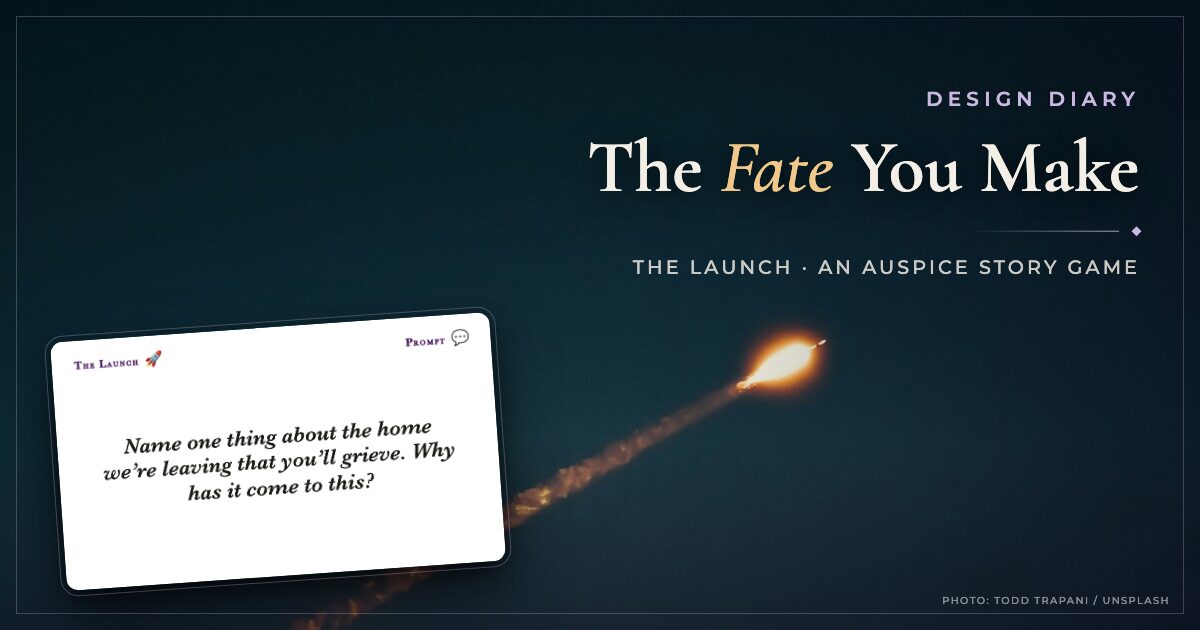
Image: a cover for The Launch, a GM-less prompt game by Christopher Allen, published by Dyvers Hands Productions. Launch photograph by Todd Trapani on Unsplash.